Five days. Five simple shifts. Less stress, more you.
start feeling calmer without changing everything at once.

THOUGHTS
FROM THE ROAD AHEAD
For women who are tired of running on empty.
Thoughts, stories, and practical support for changing the patterns underneath stress, overwhelm, and overdoing.
NLP Sounds Complicated. Here’s What It Can Look Like in a Real Coaching Session.
The first time most people hear “NLP,” it sounds far more complicated than the work actually feels.
Neuro-Linguistic Programming.
Not exactly a phrase that makes you immediately think, “Oh yes, that sounds like something that could help me stop saying yes to things I don’t want to do.”
But in a coaching session, NLP can look surprisingly ordinary.
It can start with one sentence.
A client might say:
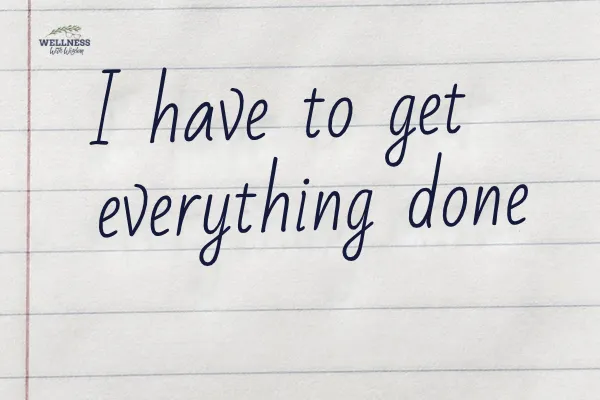
“I have to get everything done before I can relax.”
Most of us hear that sentence and move on.
There is laundry.
Emails.
Work.
Kids.
Appointments.
Of course she has things to get done.
But I might hear something else.
I hear have to.
And that makes me curious.
Who says everything has to be done?
What counts as everything?
What happens if it isn’t?
Can she relax when something is unfinished?
And if she did sit down while there were still dishes in the sink or emails unanswered, what would she make that mean about herself?
That is where the interesting part often begins.
The words we use can reveal the rules we’re living by
We all have internal rules.
Most of them don’t feel like rules because we have repeated them for so long that they simply feel true.
A good mom should...
A successful woman has to...
I can’t disappoint people.
I need to...
I shouldn’t...
I always...
I never...
You probably don’t wake up every morning and consciously decide to live according to those rules.
They just run.
And sometimes they run so quietly that we don’t recognize how much they are influencing our decisions.
The woman who says she can’t say no may technically be capable of saying the word.
The more interesting question is:
What does saying no represent to her?
Maybe no means selfish.
Maybe no means disappointing someone.
Maybe no means being difficult.
Maybe no means risking someone being upset with her.
If that is what her brain has connected to saying no, then another Pinterest graphic about boundaries probably isn’t going to solve the problem.
She already knows she needs boundaries.
We need to understand what keeps making the boundary feel unsafe.
This is one way NLP enters a coaching conversation
One of the things I pay attention to is how someone represents her problem to herself.
The language.
The meaning.
The assumptions underneath it.
The things she speaks about as if they are facts.
“I have no self-control.”
“I’m just an emotional eater.”
“I’ve always been this way.”
“I can’t stick to anything.”
Those statements don’t just describe a behaviour.
Sometimes they start defining the person.
There is a big difference between:
“I ate when I wasn’t hungry last night.”
and
“I have no control around food.”
The first describes something that happened.
The second tells a story about who you are.
And once something becomes part of your identity, changing it can feel much harder.
We’re looking for the pattern, not trying to catch you saying the wrong word
I want to be really clear about this because sometimes conversations about language can sound like we need to police every word we use.
That isn’t the point.
I’m not sitting in a coaching session waiting to pounce when someone says “should.”
I’m listening.
Because sometimes a word gives us a doorway.
It gives us somewhere useful to explore.
A woman may come to me because she wants to stop eating at night.
We may eventually discover that night eating is one of the only times she allows herself comfort.
Another may want help with procrastination.
We might discover that procrastinating protects her from finding out whether the thing she created is “good enough.”
Another may want boundaries.
We discover she learned a long time ago that being helpful made her valuable.
Now the behaviour makes more sense.
That doesn’t mean we need to keep it.
It means we finally understand what we’re actually trying to change.
Most of us try to change the final step
This is one of the biggest differences between simply giving advice and doing deeper pattern work.
We often attack the last visible behaviour.
Stop eating the food.
Say no.
Put the phone down.
Start the project.
Go to bed.
But I’m interested in the five steps before that.
What happened?
What did you think?
What did you feel?
What meaning did you make?
What did your brain decide would make things feel better, safer or easier?
The behaviour is often the end of a much longer sequence.
If we understand the sequence, we have more places to intervene than simply telling ourselves to “be stronger” at the very end.
NLP doesn’t have to feel complicated
In my work, it often looks like curiosity.
Listening closely.
Slowing down a sentence.
Questioning something you have assumed was true for years.
Separating what happened from what you made it mean.
Looking at the pattern underneath the behaviour instead of immediately trying to force the behaviour to stop.
Which is why so much of my work comes back to the same idea:
It’s not always a willpower problem. Sometimes it’s a pattern problem.
And patterns become a lot easier to change once we can actually see them.
Related reading
If this idea is new to you, start with It’s Not a Willpower Problem. It’s a Pattern Problem.
You might also like What I’m Listening For When You Say, “I Know What to Do.”
If you keep thinking, “I know what I should do, so why can’t I just do it?”, this is exactly the kind of work I do with clients.
You can learn more about coaching with me here learn more here:

Join The Road Ahead
Small shifts, honest stories, and practical support for women tired of running on empty.


Copyright © 2026 - Wellness with Wisdom