Five days. Five simple shifts. Less stress, more you.
start feeling calmer without changing everything at once.

THOUGHTS
FROM THE ROAD AHEAD
For women who are tired of running on empty.
Thoughts, stories, and practical support for changing the patterns underneath stress, overwhelm, and overdoing.
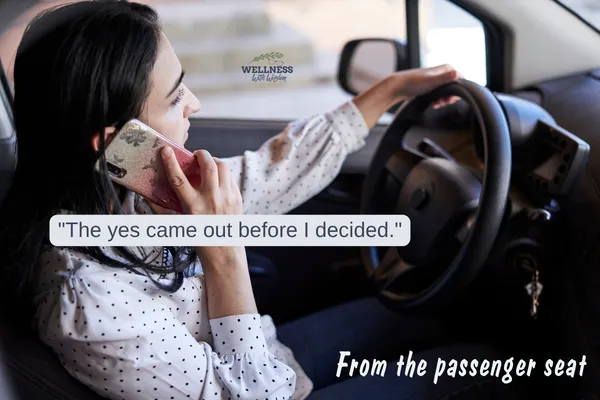
Why Do I Say Yes Before I’ve Even Decided If I Want To?
Have you ever agreed to something and almost immediately thought:
Why did I say yes to that?
Someone asks if you can help.
Volunteer.
Take something on.
Drive someone somewhere.
Cover something.
Organize something.
And somehow the yes comes out before you have even checked your calendar, your energy or whether you actually want to do it.
Then comes the resentment.
Or the rushing.
Or the mental juggling.
Or the conversation with yourself later:
I need to get better at boundaries.
Maybe.
But I’m often much more curious about what happened in the two seconds before the yes.
Sometimes “yes” isn’t really a decision
For some women, saying yes has become automatic.
There isn’t a long internal debate.
There isn’t a careful weighing of capacity.
The request comes in and the answer is already halfway out.
Then the conscious brain catches up afterward.
That is a pattern.
And simply knowing you need better boundaries doesn’t automatically change it.
Because somewhere along the way, saying yes may have become connected to something much bigger than the request itself.
What if no feels worse than yes?
Imagine someone asks you for help.
Technically, you could say:
“I can’t this time.”
But before you do, your brain may run through an entire invisible sequence.
She’ll be disappointed.
She’ll think I’m selfish.
It’s easier if I just do it.
I don’t want to make this awkward.
They’re counting on me.
Nobody else is going to do it properly.
I should be able to handle this.
So you say yes.
The task may cost you three hours.
But in that moment, saying yes saves you from something else.
Discomfort.
Guilt.
Conflict.
Judgment.
The possibility of disappointing someone.
When we understand that, the pattern becomes much more interesting than “I have bad boundaries.”
I hear versions of “it’s just easier if I do it” all the time
That sentence catches my attention.
Because sometimes it genuinely is easier in the short term.
Doing it yourself may be faster than explaining.
Agreeing may be easier than having an uncomfortable conversation.
Taking over may feel easier than watching someone do something differently from you.
But easier right now can become exhausting later.
One automatic yes isn’t usually the problem.
It’s what happens when dozens of them pile up.
You become the reliable one.
The capable one.
The one everybody calls.
The one who remembers.
The one who fixes things.
And eventually you are exhausted and wondering why nobody seems to notice how much you are carrying.
Sometimes nobody notices because you have become exceptionally good at carrying it.
The goal isn’t to become someone who says no to everything
Boundary conversations can get very black and white.
Say no.
Protect your peace.
Stop people pleasing.
That sounds simple until you are sitting across from someone you love who genuinely needs help.
You probably don’t want to become a person who never helps anyone.
You want a choice.
That’s the difference.
Instead of the request automatically producing yes, we create enough space for you to decide.
Do I want to?
Do I have the capacity?
Is this actually mine to carry?
Am I saying yes because I choose to, or because saying no feels uncomfortable?
That pause can tell us a lot.
Sometimes the pattern started a long time ago
Maybe you became the helpful one.
The responsible one.
The peacemaker.
The child who didn’t cause trouble.
The person who noticed what needed doing before anyone asked.
Those identities can follow us into adulthood.
And the qualities themselves aren’t bad.
Being caring is wonderful.
Being capable is a strength.
Helping people matters.
The issue is when helping stops being something you choose and starts becoming something you feel responsible for doing.
That is where resentment and burnout often begin.
So the next time you hear yourself say yes...
Don’t immediately criticize yourself.
Get curious.
What would have felt uncomfortable about saying no?
What were you afraid the other person might think?
What did saying yes allow you to avoid?
What rule were you following?
“I should help.”
“I don’t want to be difficult.”
“They need me.”
“I can handle it.”
“I’ll figure it out.”
Those little statements can tell us much more about the pattern than another lesson on how to say the word no.
Because sometimes the problem isn’t that you don’t know how to set a boundary.
You know the words.
The work is understanding why using them feels so hard.
And that is a very different conversation.
Related reading
This connects closely with It’s Not a Willpower Problem. It’s a Pattern Problem.
And if you want to understand what I’m paying attention to during conversations like this, read What I’m Listening For When You Say, “I Know What to Do.”
If you recognize yourself in the automatic yes, the overthinking afterward, or the feeling that everyone needs something from you, that is exactly the kind of pattern we can explore in coaching.

Join The Road Ahead
Small shifts, honest stories, and practical support for women tired of running on empty.


Copyright © 2026 - Wellness with Wisdom